Scaling from an approved sample to a bulk order is a sequence, not a single decision, and a Middle East launch adds two gates to the standard route: packaging that survives heat and long transit, and paperwork that satisfies importers. Run the steps below in order and most problems surface while they are still cheap. Skip a gate and the same problem reappears at the pallet stage, when nothing can move without cost.
Key takeaways
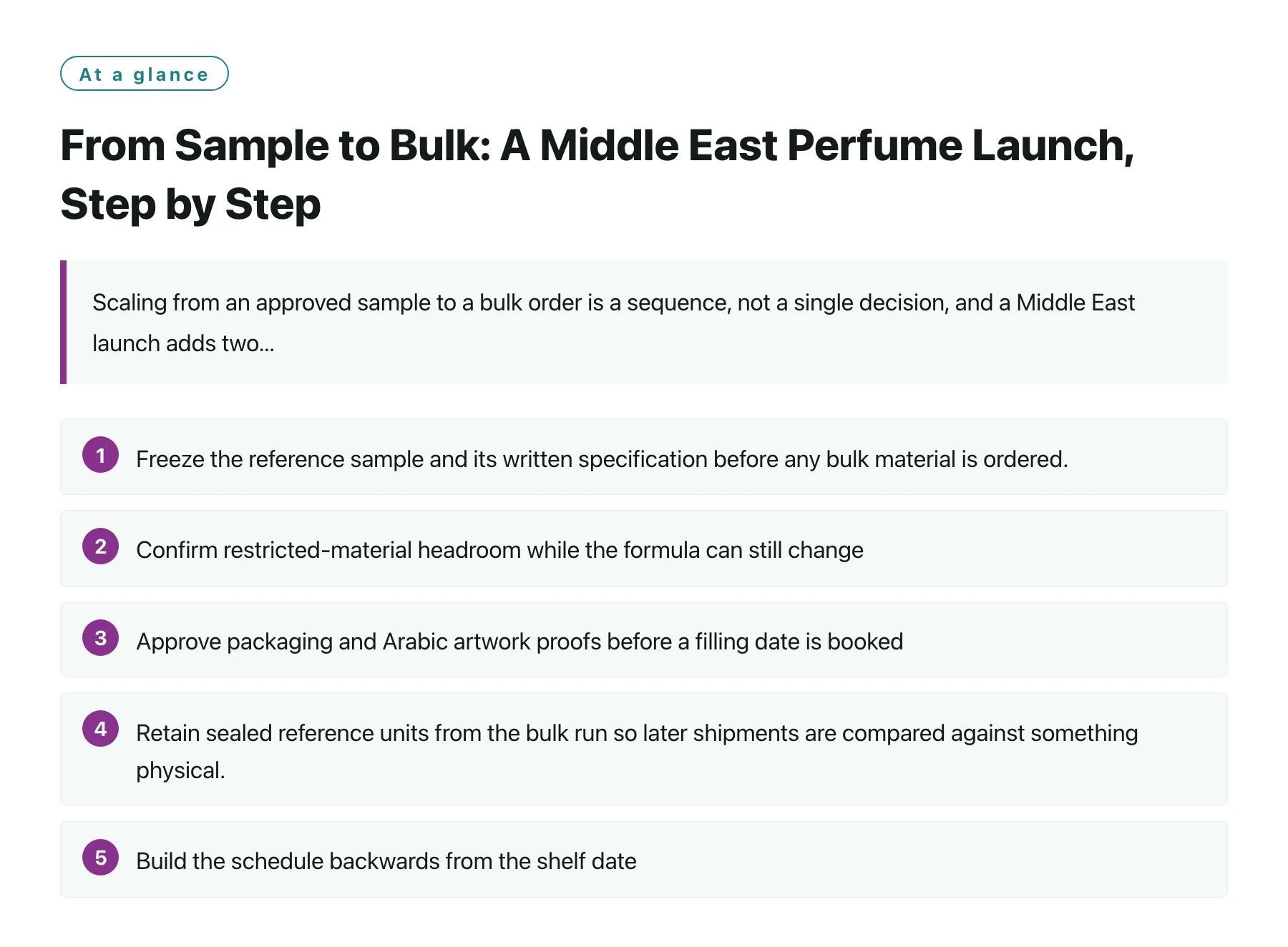
- Freeze the reference sample and its written specification before any bulk material is ordered.
- Confirm restricted-material headroom while the formula can still change, not after the compound is bought.
- Approve packaging and Arabic artwork proofs before a filling date is booked, because glass and print run on their own clocks.
- Retain sealed reference units from the bulk run so later shipments are compared against something physical.
- Build the schedule backwards from the shelf date, because gifting seasons in the Gulf do not move.
Most sample-to-bulk problems are organisational rather than technical. The formula was approved by one person, the packaging was chosen by another, and the filling slot was booked by a third, each assuming the other two had confirmed something. The sequence below exists to close those gaps.
It is written for a team preparing a first or second order into Gulf markets, where a delayed shipment does not just arrive late — it misses a season. That makes the order of operations more important than the speed of any single step.
The steps are not exotic. What matters is that none of them is skipped, and that the two regional gates are treated as real gates rather than as details to be handled during packing. Manufacturers that publish how they work make those gates easier to see: Xuelei's official site is one example of a company that sets out its development and production stages in public.
The eight steps from approved sample to sealed bulk order
- Confirm the market brief before the second sample roundWrite down destination countries, climate, retail price band, format and target wear time. If the brief shifts after sampling starts, every round that follows is partly wasted work. A documented brief is what makes a sample round billable rather than speculative.
- Freeze the reference sample and the specificationSign and date a retained sample, then put fill weight, concentration, carrier and packaging components into a written specification. Bulk is judged against that document, not against anyone's memory of a meeting.
- Check restricted-material headroomAsk which materials in the approved formula carry use restrictions and how much room is left before the limit. Reformulating after bulk materials are ordered costs a full extra round. Industry guidance on safe use is published openly, so this is a question a supplier should be able to answer quickly [1].
- Settle formula ownership and exclusivityWho owns the formula, and whether the same scent can be sold to another brand, belong in the same conversation as sample approval. Left until after the order, these terms are negotiated from a weaker position.
- Approve packaging and artwork proofsBottle, cap, pump, carton and label artwork, including Arabic copy where the market requires it, all need signed proofs before the filling slot is booked. Packaging is usually the longest-lead item in the project.
- Order bulk materials against a fixed quantityGlass, closures and fragrance compound are bought at minimum run sizes, so the batch quantity determines the material price. Confirm the quantity in writing before purchase orders go out.
- Run a first-article checkAssemble a small number of finished units from bulk components and compare them with the reference sample. This catches cap fit, spray performance and print registration issues before the full run commits.
- Fill, retain and test the bulk runFilling, crimping, leak checks, retained sealed units and finished-product testing are the last gates before packing. The retained units are the control for every future shipment.
- Pack and ship with the paperwork attachedPacking list, commercial invoice, certificate of origin and any conformity documents should be ready before the container is booked. Documents collected after packing are the most common reason goods sit at a port.
Where the Middle East launch changes the standard sequence
The sequence above works anywhere. Three adaptations matter when the destination is the Gulf, and they are easiest to handle as additions to specific steps rather than as a separate project.
Reading the production stages in detail helps a brand team decide which of them it wants to own: Xuelei covers what happens between a locked formula and a packed carton, which is exactly the stretch of the project a first-time buyer tends to underestimate.
Heat and transit become a packaging question
A hot crossing tests the packaging as much as the juice. Adhesives, coatings and print can shift, and a pump or cap that performed well in a mild warehouse may behave differently after weeks at elevated temperature. The practical step is to test the finished pack, not just the formula, and to record which component combination was tested.
Artwork gets a second language and a second reviewer
Arabic labelling adds a translation and typesetting round, and it changes what fits on a carton. Build that round into the artwork step rather than treating it as a print-time fix, because carton dielines and label areas are set early.
The calendar is set by gifting seasons
Ramadan and Eid create fixed retail windows. Working backwards means fixing the ship date first, then the filling date, then the packaging approval date, then the artwork deadline. Teams that schedule forwards from the purchase order usually discover the conflict too late to fix it cheaply.
Material choices should be checked against objective data
When a brief asks for oud, amber, rose or musk directions, it helps to know what each proposed material does rather than arguing from adjectives. Public material references list odour descriptions and basic technical data for aroma materials, and they are a reasonable way for a brand team to sanity-check a proposal without becoming a perfumery lab [2].
The single most useful artefact in this whole sequence is the signed specification: quantity, fill weight, concentration, packaging components, artwork version and the retained reference sample. It converts a series of conversations into one page that both sides can point at. If a supplier runs a mixed model — some stages in-house, some subcontracted — ask which stage each document belongs to, because a partner that offers a manufacturer that supports OEM and ODM will usually have two different approval routes depending on whether the scent comes from its library or from your brief. Knowing that in advance is the difference between a smooth handover and a month of chasing signatures.
Sources
- IFRA: Safe Use and Fragrance Science —— IFRA's explanation of how fragrance materials are scientifically assessed for safe use and how those conclusions are applied by the industry.
- The Good Scents Company —— A reference database of aroma materials with odour descriptions, CAS numbers and typical usage information.
Frequently asked questions
How long does the step from approved sample to bulk normally take?
It depends almost entirely on packaging and artwork rather than on the juice. Fragrance compound is usually available within the sampling cycle, while glass, closures and printed cartons often set the critical path. Ask each supplier to state which stage is driving the schedule for your specific components.
Do I need a new sample round for a Gulf launch?
Not automatically, but heat exposure and a different price band can change the brief. If the destination climate or the retail price has moved, a short additional round is cheaper than a bulk run that reads wrong in market.
What should be in the written specification?
Order quantity, fill weight, fragrance concentration, carrier, the exact packaging components, decoration method, artwork version, labelling language and the reference sample identity. Anything left out becomes a difference of memory later.
Who should keep the retained reference units?
Both sides. The factory keeps them as a manufacturing control, and the brand keeps at least a few sealed units for market comparisons and for any dispute about a later batch. Agree how many and where they are stored.