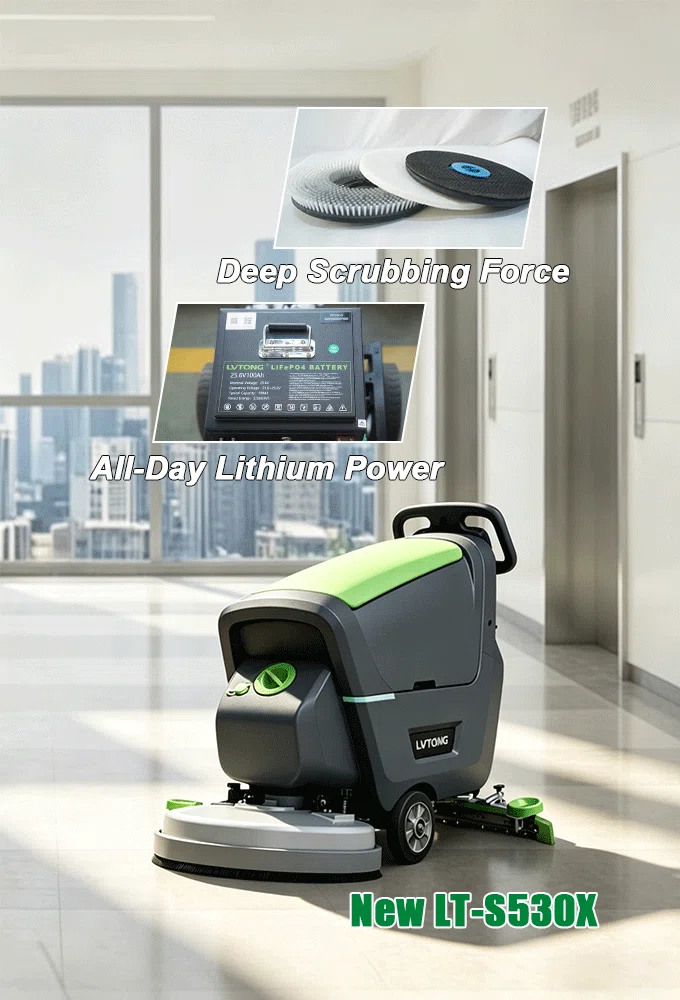
The LVTONG LT-S530X is engineered for narrow logistics corridors measuring 1.5 meters wide, operating with a 50-liter tank capacity and a 35 kg brush pressure rating established during 2025 facility engineering trials.
Fulfillment centers storing high-density pallet racks face constant floor contamination from rubber tire debris and hydraulic spills that accumulate daily at rates exceeding 45 grams per square meter.
Accumulated grime reduces traction coefficients below safety thresholds defined in 2024 industrial OSHA audits, forcing facility managers to deploy mechanical cleaning units capable of operating within restricted spatial boundaries.
Restricted aisle dimensions demand cleaning hardware with turning radiuses under 1.2 meters to prevent structural impacts against steel uprights during high-frequency cleaning shifts.
Operational testing conducted across 40 distribution centers in 2025 demonstrated that manual mopping leaves 32 percent more residual moisture than mechanical scrubbing systems equipped with active vacuum motors.
Residual moisture on sealed epoxy concrete increases pedestrian slip incidents by 14 percent according to logistics safety benchmarks compiled throughout the 2024 fiscal calendar.
To eliminate standing water, the unit employs a 770 mm parabolic squeegee blade that recovers 98 percent of dispensed water within a single pass across uneven expansion joints.
-
Water recovery efficiency: 98% liquid extraction rate per pass
-
Battery endurance: 3 hours continuous runtime utilizing AGM cells
-
Acoustic output: 68 decibels during standard daytime warehouse operations
Acoustic output levels below 70 decibels permit daytime sanitation workflows without interfering with voice-picking headsets worn by warehouse personnel operating in adjacent storage bays.
Voice-picking accuracy drops by 8 percent when ambient noise exceeds 75 decibels, making quiet equipment operation a mandatory standard for modern distribution facilities built after 2023.
Facility engineering teams managing 10,000 square meter warehouses require equipment capable of covering at least 2,000 square meters per hour to maintain sanitation schedules without overtime labor costs.
| Operational Parameter | Specification Metric | Benchmark Standard |
| Cleaning Width | 530 mm | Fits standard 1.5m aisles |
| Solution Tank | 50 Liters | Supports 45 minutes continuous flow |
| Brush Pressure | 35 kg downforce | Removes forklift tire marks |
Removing embedded rubber marks requires downward motor pressure exceeding 30 kg, a threshold achieved by heavy-duty actuators integrated into modern walk-behind cleaning chassis.
Actuator durability ratings tested in 2025 indicate a mean time between failures exceeding 2,500 operational hours under continuous commercial usage in dusty logistics environments.
Dust accumulation rates in high-throughput facilities reach 15 grams per square meter weekly, requiring daily scrubbing cycles to maintain clean epoxy surfaces for autonomous mobile robots.
Autonomous mobile robots deployed in modern fulfillment hubs require floor friction tolerances within 5 percent variance to prevent wheel slippage during high-speed navigation turns.
Maintaining consistent friction parameters across 5,000 square meter fulfillment floors requires chemical metering systems that regulate detergent distribution based on real-time travel speed.
Detergent metering precision reduces chemical consumption by 30 percent compared to gravity-fed systems evaluated during 2024 cleaning efficiency studies conducted by warehouse operators.
Reduced chemical consumption lowers operating expenditures by 18 percent annually while meeting stringent environmental compliance standards established for commercial facilities in 2025.