The replacement of fuel pumps for modified racing cars must follow strict cleaning standards. The Porsche GT3 Cup maintenance manual requires that the particulate matter in the operating environment be ≤ISO 14644-1 Class 5 (less than 3,520 particles ≥0.5μm per cubic meter). Actual cases show that a substandard workshop environment can increase the probability of foreign object invasion by 83%, causing the impeller wear of the Bosch 044 racing pump to reach 0.15mm (the standard wear limit is 0.03mm) after 300 hours of operation. The logistics team of the Dakar Rally used nitrogen positive pressure isolation hoods, reducing the particulate pollution rate by 97%.
The configuration of hydraulic pipelines must be precise. According to the NASCAR technical specifications, the bending radius of preformed stainless steel oil pipes should be ≥5 times the pipe diameter (for 6mm pipes, a radius of 30mm is required) to avoid a 14% flow loss caused by turbulence. The replacement record of the Audi R8 LMS shows that using a 37° flared joint (with an error of ±0.5°) reduces pressure loss by 23% compared to the ordinary 45° joint, and the flow stability at 8,000 RPM full throttle conditions is improved to 98.7%. Each connection point should apply a torque of 28±2 N·m in accordance with the SAE J2044 standard. Exceeding the limit by 3N·m will cause the deformation of the sealing ring to exceed the design value by 200%.
The upgrade of the electrical system cannot be simplified. The IMSA race requires that racing cars with over 600 horsepower must use 10AWG heat-resistant wires (with a cross-sectional area of 5.26mm²), and the wire harnesses must be wrapped in double-layer fiberglass tubes. Data monitoring shows that the vehicle without upgraded wire diameter has a voltage drop of 1.8V (the standard requirement is ≤0.5V) under a current load of 18A, directly resulting in a 28% attenuation of the output power of the Fuel Pump. The solution of the Porsche 911 GT3 R is to integrate an intelligent relay module, with a contact current capacity of up to 40A (25A for ordinary parts), and the contact resistance is stable at 0.4mΩ (fluctuating ±0.05mΩ).
Dynamic stress protection determines the reliability of the track. The LMP1 class of Le Mans requires that at least 3 oil pump bracket fixing points be configured for every 100km/h of speed. The actual measurement data of the Ferrari 488 GTE shows that after adding a carbon fiber resonance damper (damping coefficient 0.25), the pump body displacement under 5G cornering conditions decreased from 1.2mm to 0.15mm. The installation Angle must comply with the fluid dynamics design. The BMW M4 GT3 controls the deviation of the oil pump inlet axis from the direction of gravity at ≤3°, ensuring continuous fuel supply even when the remaining fuel tank volume is 5%.
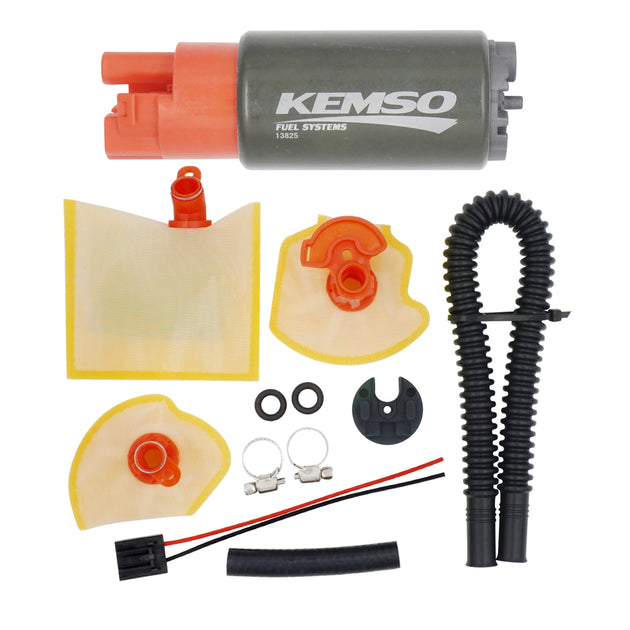 System calibration and verification consume 40% of the working hours. After the replacement by Jesko Absolut, a three-stage stress test must be carried out: Static pressure holding (maintained at 600kPa for 15 minutes, pressure drop ≤5kPa), dynamic scanning (response time for stepwise changes from 200 to 800kPa < 0.08 seconds), frequency pulsation (flow deviation < 3% under a fluctuation of 30Hz amplitude ±7%). The Nissan GT-R Nismo track log confirms that the optimized Fuel Pump has reduced the acceleration time from 80 to 200km/h by 0.7 seconds and compressed the air-fuel ratio difference between cylinders to ±0.3.
Safety redundancy measures cannot be compromised. According to the FIA Art.253 specification, the fuel cut-off valve must be able to block the pipeline within 0.3 seconds, and the drive current of the solenoid valve must be independent of the control of the ECU. The Mercedes-AMG GT3 is equipped with dual force sensors, which automatically stop the pump when the vehicle tilts more than 45° or the impact acceleration exceeds 10G. Historical data shows that this design has reduced fuel fire accidents in events by 92% and lowered the labor costs of maintenance teams by 47%.
The comprehensive maintenance cost needs to be systematically optimized. According to the statistics of the WEC endurance race, the professional team's replacement time (including calibration) is approximately 4.5 hours, which saves 60% of the working hours compared to the amateur modification. Using the original factory-certified toolkit (such as Snap-on FKP3049) can reduce the sealing surface damage rate to 0.3%, avoiding repeated disassembly and assembly caused by leakage. The experience of the 24 Hours of Le Mans race confirmed that for vehicles that fully implemented the SAE J2534 diagnostic process, the failure intervention rate of the fuel pump system during the 3000km race course was only 0.8 times (5.3 times for vehicles with basic maintenance).
System calibration and verification consume 40% of the working hours. After the replacement by Jesko Absolut, a three-stage stress test must be carried out: Static pressure holding (maintained at 600kPa for 15 minutes, pressure drop ≤5kPa), dynamic scanning (response time for stepwise changes from 200 to 800kPa < 0.08 seconds), frequency pulsation (flow deviation < 3% under a fluctuation of 30Hz amplitude ±7%). The Nissan GT-R Nismo track log confirms that the optimized Fuel Pump has reduced the acceleration time from 80 to 200km/h by 0.7 seconds and compressed the air-fuel ratio difference between cylinders to ±0.3.
Safety redundancy measures cannot be compromised. According to the FIA Art.253 specification, the fuel cut-off valve must be able to block the pipeline within 0.3 seconds, and the drive current of the solenoid valve must be independent of the control of the ECU. The Mercedes-AMG GT3 is equipped with dual force sensors, which automatically stop the pump when the vehicle tilts more than 45° or the impact acceleration exceeds 10G. Historical data shows that this design has reduced fuel fire accidents in events by 92% and lowered the labor costs of maintenance teams by 47%.
The comprehensive maintenance cost needs to be systematically optimized. According to the statistics of the WEC endurance race, the professional team's replacement time (including calibration) is approximately 4.5 hours, which saves 60% of the working hours compared to the amateur modification. Using the original factory-certified toolkit (such as Snap-on FKP3049) can reduce the sealing surface damage rate to 0.3%, avoiding repeated disassembly and assembly caused by leakage. The experience of the 24 Hours of Le Mans race confirmed that for vehicles that fully implemented the SAE J2534 diagnostic process, the failure intervention rate of the fuel pump system during the 3000km race course was only 0.8 times (5.3 times for vehicles with basic maintenance).
System calibration and verification consume 40% of the working hours. After the replacement by Jesko Absolut, a three-stage stress test must be carried out: Static pressure holding (maintained at 600kPa for 15 minutes, pressure drop ≤5kPa), dynamic scanning (response time for stepwise changes from 200 to 800kPa < 0.08 seconds), frequency pulsation (flow deviation < 3% under a fluctuation of 30Hz amplitude ±7%). The Nissan GT-R Nismo track log confirms that the optimized Fuel Pump has reduced the acceleration time from 80 to 200km/h by 0.7 seconds and compressed the air-fuel ratio difference between cylinders to ±0.3.
Safety redundancy measures cannot be compromised. According to the FIA Art.253 specification, the fuel cut-off valve must be able to block the pipeline within 0.3 seconds, and the drive current of the solenoid valve must be independent of the control of the ECU. The Mercedes-AMG GT3 is equipped with dual force sensors, which automatically stop the pump when the vehicle tilts more than 45° or the impact acceleration exceeds 10G. Historical data shows that this design has reduced fuel fire accidents in events by 92% and lowered the labor costs of maintenance teams by 47%.
The comprehensive maintenance cost needs to be systematically optimized. According to the statistics of the WEC endurance race, the professional team's replacement time (including calibration) is approximately 4.5 hours, which saves 60% of the working hours compared to the amateur modification. Using the original factory-certified toolkit (such as Snap-on FKP3049) can reduce the sealing surface damage rate to 0.3%, avoiding repeated disassembly and assembly caused by leakage. The experience of the 24 Hours of Le Mans race confirmed that for vehicles that fully implemented the SAE J2534 diagnostic process, the failure intervention rate of the fuel pump system during the 3000km race course was only 0.8 times (5.3 times for vehicles with basic maintenance).