Downloading the App: What Changes on Mobile
The mobile app does not change what an AI chat is; it changes when and where you have one. The iOS build is listed as CrushMash, Android is offered as a direct download, and the practical difference shows up in session shape rather than in features. Five twelve-minute sessions a week is 60 minutes, which is 258 minutes or about 4.3 hours a month - small on paper, and noticeably easier to spend from a phone than from a desk.

Key takeaways
- Notifications only exist once you install the app and grant the permission; a browser tab cannot interrupt you, for better or worse.
- Mobile sessions run shorter and more often: five a week at twelve minutes is 258 minutes a month, against one long evening on a laptop.
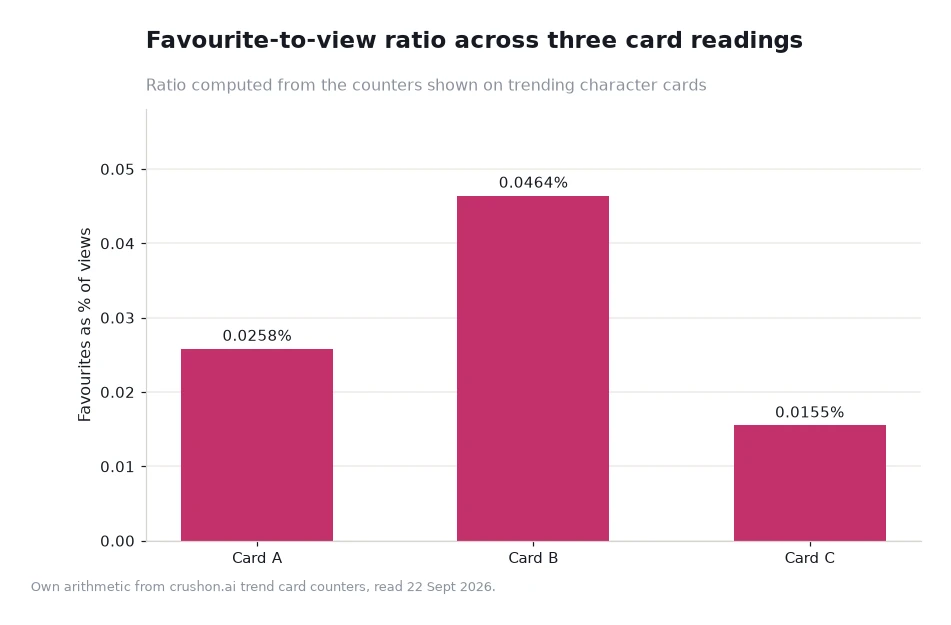
- A "keep" rate of 0.0258% to 0.0464% across card readings is what favourites-to-views arithmetic looks like; mobile makes favouriting easier and writing longer messages harder.
- The Creators and Characters leaderboards work the same on both surfaces, so switching devices costs you navigation habits, not access.
What the download actually changes
Three things change when you move from a browser tab to an installed app, and only three. The first is interruption: an installed app can ask for notification permission, so a reply or a new character can reach you when the app is closed. A browser tab cannot do that unless you leave it open and pinned, which is the reason some readers deliberately stay on the web.
The second is layout. A phone gives you one column, a shelf that shows two or three cards at a time instead of eight, and controls within thumb reach. That changes browsing speed in both directions: fewer cards per screen means more swipes, but a single card fills the display, so descriptions get read more closely than they do in a wide grid.
The third is session shape. Desktop sessions tend to be long and occasional, because opening a laptop is a decision. Phone sessions are short and frequent, because the device is already in your hand. Neither is better; the arithmetic simply lands in a different place, and it is worth knowing which pattern you are actually running before you judge how much time the habit takes.
Where the counters and the habits meet
Mobile use mostly changes the reader's side of the ledger, not the platform's. Views and favourites are the two counters shown on every card, and the ratio between them behaves the same on a phone as on a laptop: three readings used in this piece produced 0.0258%, 0.0464% and 0.0155%, a spread of just under three times between the highest and lowest.
What a phone changes is your own bias inside that ratio. Favouriting a card takes one thumb movement, so you will probably keep more cards on mobile than in a browser. Typing a long message is slower, so you will probably write shorter ones. The ratio on the card stays a description of other readers; the ratio in your own account drifts toward whichever action your device makes cheap.
That is a useful thing to check once. Open your own history on both surfaces, count the cards you kept in the last month, and compare it with the number of sessions you actually held. If the two numbers are far apart, mobile has been collecting intentions rather than conversations.
| Task | In a browser tab | In the installed app |
|---|---|---|
| Being alerted to a reply | Only if the tab stays open | Available after you grant notification permission |
| Browsing a shelf | Wide grid, many cards visible at once | One column, two or three cards per screen |
| Reading a description | Comparisons across cards in one view | One card fills the screen, so it is read closely |
| Keeping a card | Takes a deliberate click | One thumb movement, so it happens more often |
| Writing a long message | Comfortable with a full keyboard | Shorter messages, more of them |
| Checking rankings | Weekly charts, refreshed every Thursday | The same charts, arranged for a narrow screen |
Worked example: a month of phone sessions in minutes
Build the month from the session first. Five sessions a week at twelve minutes is 60 minutes a week, and 60 times 4.3 weeks is 258 minutes, which is 4.3 hours across the month. If two of those sessions stretch to twenty minutes each, the total rises to 290 minutes, an increase of 32 minutes for two decisions rather than a change of habit.
Now add the message side from the chart below, which uses daily counts multiplied by a 30-day month: 4 messages a day gives 120, 18 gives 540, and 60 gives 1,800. Take the middle figure of 540. At 30 seconds of typing per message that is 270 minutes, or 4.5 hours - almost exactly the time budget of the session arithmetic above, which tells you that a mid-band habit and a five-session week describe the same month in two different units.
Both calculations are illustrative. They are assumptions built to show the multiplication, not records of anyone's account and not platform data, and they exclude time spent reading replies, which is usually the larger half.
Mobile habits worth setting up once
Decide the notification question deliberately. Interruption is the main functional gain of an installed app, and it is also the fastest way to turn a habit into an ambient one that follows you into other rooms. If you want the app but not the interruptions, leave the permission off and open the app when you intend to use it; the trade is one extra tap per session.
Then decide where the app lives. The platform is one address regardless of device - https://crushon.ai/ opens the same account in a browser, and the app is a different frame around it - so there is no need to keep accounts or characters in two places. What is worth separating is context: keep the app off the home screen if you use the phone for work, and keep chat sessions out of the hours you already protect for other people.
Finally, use the browsing tools that survive the move to a small screen. The character search page works better than a shelf when you already know what you want, because filters replace scrolling. The weekly rankings are worth checking once a week rather than once a day, since the charts refresh every Thursday and nothing moves in between.
Frequently asked questions
Is the app different from the website?
It is a different frame around the same account. The characters, memories and counters are the same, while notifications, layout and session length change with the device.
Do I need to install anything to use the platform?
No. A browser works on its own. The iOS build is listed as CrushMash and Android is offered as a direct download for readers who want notifications and a phone-shaped layout.
Does mobile use cost more time?
Not by itself. Five twelve-minute sessions a week is 258 minutes a month, which is close to the 270 minutes that 540 messages a month take to type at 30 seconds each.
Install for the habit you want, not the one you have
Write down the session shape you want before you download, then let the app match it. If you want short breaks, install it and leave notifications on; if you want long, deliberate sessions, install it and turn notifications off. Check the arithmetic a month later: total minutes from your own sessions against the message counts in the chart, on the same month, in the same units. Whichever way the numbers land, they will tell you more about the habit than the download did.
Sources: navigation labels, card counters and app details as published on the Crushon pages and store listings, read 22 Sept 2026[1]. Session and message figures are own arithmetic shown as an illustrative profile and are not platform data. This article is written for adults; the platform and its apps are intended for users aged 18 and over.