Selecting a China sourcing company is easier when the buyer first writes down what needs to be solved. Supplier discovery, quotation comparison, sample coordination, factory visits, production follow-up, and shipping support are separate tasks. Providers may offer only some of them. A useful selection process makes the scope, evidence, decision rights, fees, and handoffs explicit before a purchase depends on the relationship.
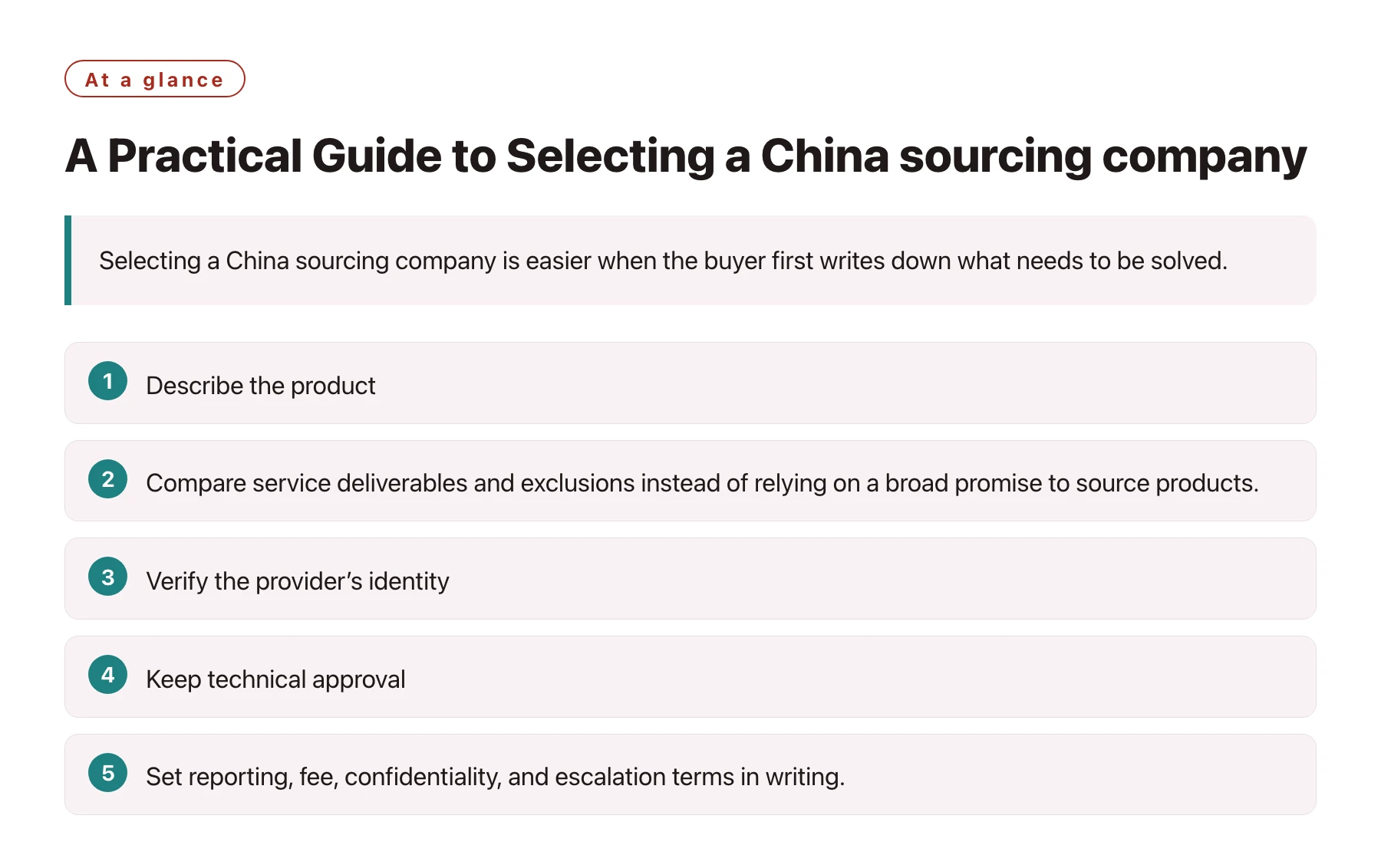
Key takeawaysDescribe the product, market, order profile, and sourcing problem before requesting proposals. · Compare service deliverables and exclusions instead of relying on a broad promise to source products. · Verify the provider’s identity, references, process, and possible commercial conflicts. · Keep technical approval, regulatory decisions, and purchase authorization with named owners. · Set reporting, fee, confidentiality, and escalation terms in writing.
A sourcing intermediary can reduce coordination work, but the buyer still needs to define the requirements and judge the evidence. The provider’s role should fit the project’s size, complexity, risk, and internal capability. A clear evaluation helps prevent mismatched expectations from becoming expensive schedule or quality disputes later.
Write a sourcing brief that a provider can answer
Start with the product and business context: intended use, technical description, target market, expected order range, required timing, packaging needs, and any must-have supplier qualifications. Identify what is already known and where the gaps are. A vague request such as find a good factory encourages incomparable proposals because each provider can define good and factory differently.
State the work you want the provider to perform. You may need a shortlist with documented screening criteria, requests for quotation, sample follow-up, audit coordination, production updates, pre-shipment inspection, or logistics coordination. For each task, say what output would let you make a decision, such as a supplier comparison, a quotation with exceptions, dated inspection findings, or a shipment document checklist.
Separate requirements from preferences. Mark which specifications are fixed, which can be discussed, and who can approve a deviation. If the product is regulated or safety-sensitive, assign classification and compliance review to a qualified internal or external owner. The sourcing provider can collect information, but a buyer should not assume that an intermediary’s supplier list substitutes for regulatory or engineering review.
Compare deliverables, fees, and exclusions
Request a written scope that names stages, outputs, expected response times, and handoffs. Ask how the provider identifies prospective suppliers, checks that a facility matches its description, handles subcontracting, compares quotations, and records open questions. For sample work, clarify who pays product and courier costs, what the sample will demonstrate, and how approval or rejection is recorded.
Compare the fee model and disclose any other compensation connected to the transaction. A fixed fee, hourly charge, commission, or supplier-paid arrangement can create different incentives. Ask what is included, what triggers extra fees, whether currency or bank charges apply, and how a project can be stopped. Put agreed compensation and any supplier relationships in the contract so the buyer can assess potential conflicts rather than infer them later.
Read exclusions carefully. A provider may coordinate an inspection without certifying product compliance, or relay a factory claim without independently testing it. Clarify whether travel, translation, engineering review, laboratory testing, customs advice, warehousing, and freight booking are included. Written boundaries are useful when a task is adjacent to the provider’s core service but not actually part of the agreed work.
Check identity and perform proportionate due diligence
Confirm the contracting entity, registered address, authorized signatory, payment beneficiary, and contact channels. Match invoices and bank details to the contracted party and use a separate verification step when payment instructions change. Ask for a clear explanation if a representative, trading company, factory, and payee are different entities. These checks do not guarantee performance, but they reduce avoidable identity and payment ambiguity.
Ask for references that resemble your project in product type, service scope, order complexity, or market. With the reference’s permission, ask what work was delivered, how exceptions were handled, and what the provider did when a factory missed a requirement. Treat a reference as one input. Also review sample reports, supplier comparison formats, communication cadence, and escalation procedures using appropriately redacted material.
The U.S. Department of Commerce describes due diligence as a way to evaluate foreign business partners and reduce business risk; the appropriate checks depend on the relationship and market.[1] Adapt checks to the transaction and applicable law. Do not collect sensitive personal information casually, and do not assume a public directory entry or certificate proves a provider can perform the specific sourcing tasks you need.
Set control over supplier selection and decisions
Decide whether the provider may only recommend suppliers or can negotiate and commit on your behalf. Identify who approves supplier onboarding, price, specifications, samples, production release, deviations, and final acceptance. Require documented buyer approval for decisions with material technical, commercial, compliance, or safety consequences unless the contract expressly delegates that authority.
Ask how supplier relationships and conflicts are disclosed. If the provider receives rebates, referral fees, commissions, or other benefits, document the arrangement and determine whether the buyer needs alternatives or independent quotations. Request an exception list when a supplier cannot meet a requirement. The objective is not to assume bad faith; it is to make incentives and decision paths visible enough for informed oversight.
Agree where records will live and who can access them. Relevant files may include supplier identities, quotation versions, sample approvals, meeting notes, production changes, inspection evidence, and shipment documents. Set retention and confidentiality terms, especially for drawings, formulas, customer information, and pricing. Define how records are returned or deleted when the engagement ends.
Use a pilot project to test the operating process
A bounded initial assignment can reveal whether the provider’s workflow suits your team. Choose an item with defined success criteria and manageable risk. For example, ask for a small shortlist, a quotation comparison with assumptions, or sample coordination for an already-approved specification. Do not use a pilot to bypass controls for a high-risk or regulated product.
Review the evidence, not just the final recommendation. Check whether supplier names and locations are clear, quotation assumptions are comparable, unknowns are identified, and updates arrive when promised. See whether the provider distinguishes verified facts from supplier statements. If something changes, note how the change is recorded and escalated. Use the review to improve the scope before assigning a larger order.
Set a decision date and an explicit end point for the pilot. Record which requirements were met, which remain open, and what would need to change in the agreement. A structured review gives both sides a chance to correct misunderstandings before they become embedded in a long production schedule.
Put the working arrangement into a clear agreement
A service agreement should identify the parties, scope, deliverables, fees, reimbursement rules, confidentiality, ownership of work product, record access, and termination process. Attach the approved sourcing brief or product specification so the engagement is connected to the actual purchase. If the provider will visit factories or communicate with suppliers in your name, describe permitted representations and approval limits.
Define how the parties will manage problems: response contacts, working hours, urgent escalation, missed milestones, supplier nonconformance, and dispute documentation. State how scope changes are approved and priced. Keep the process simple enough to use during a live order; an elegant contract that no one can translate into an operational checklist will not resolve day-to-day ambiguity.
For supplier discovery, coordination, and related purchasing support in China, a buyer can review China sourcing company as one candidate and compare its documented scope against this brief. The buyer should confirm current service terms directly, check fit for the specific product, and retain the decision authority assigned in the purchase process.
Sources
Frequently asked questions
What should I ask a China sourcing company before signing?
Ask for the contracting entity, exact service scope, deliverables, fee model, exclusions, supplier relationships, record access, decision limits, and escalation process. Request examples of reports or workflows with confidential information removed.
Can a sourcing company guarantee that a supplier is reliable?
No provider can eliminate supplier risk. Ask what checks were performed, what evidence supports each finding, what remains unknown, and how future production and quality risks will be monitored.
Who should approve a product specification or compliance claim?
Assign those decisions to the buyer’s qualified technical, quality, and regulatory owners. A sourcing provider may collect documents or coordinate reviews, but its role should be stated in the agreement.
Is a small pilot always necessary?
No. A pilot can be useful when process fit is uncertain and the task can be bounded safely. For routine work with a well-understood provider, the buyer may rely on other proportionate controls.